Tools, honestly
That home fetal doppler cannot see what you are afraid of
People buy home dopplers for one reason: fear wants a bridge between appointments. This page is not here to scold anyone for wanting that. It is here to explain, precisely, what the device can and cannot do, what regulators actually say, and what works better when what you need is reassurance with real information in it.
The short answer
A home fetal doppler picks up one thing: the sound of a heartbeat, and its rate. It cannot see structure, which is where congenital heart disease lives. The FDA classifies these as prescription devices for trained operators and discourages home use - the documented risks are misreadings in both directions: panic when you cannot find the heart, false calm when you can. From roughly 26 weeks, fetal movement is the home signal that actually carries clinical meaning.
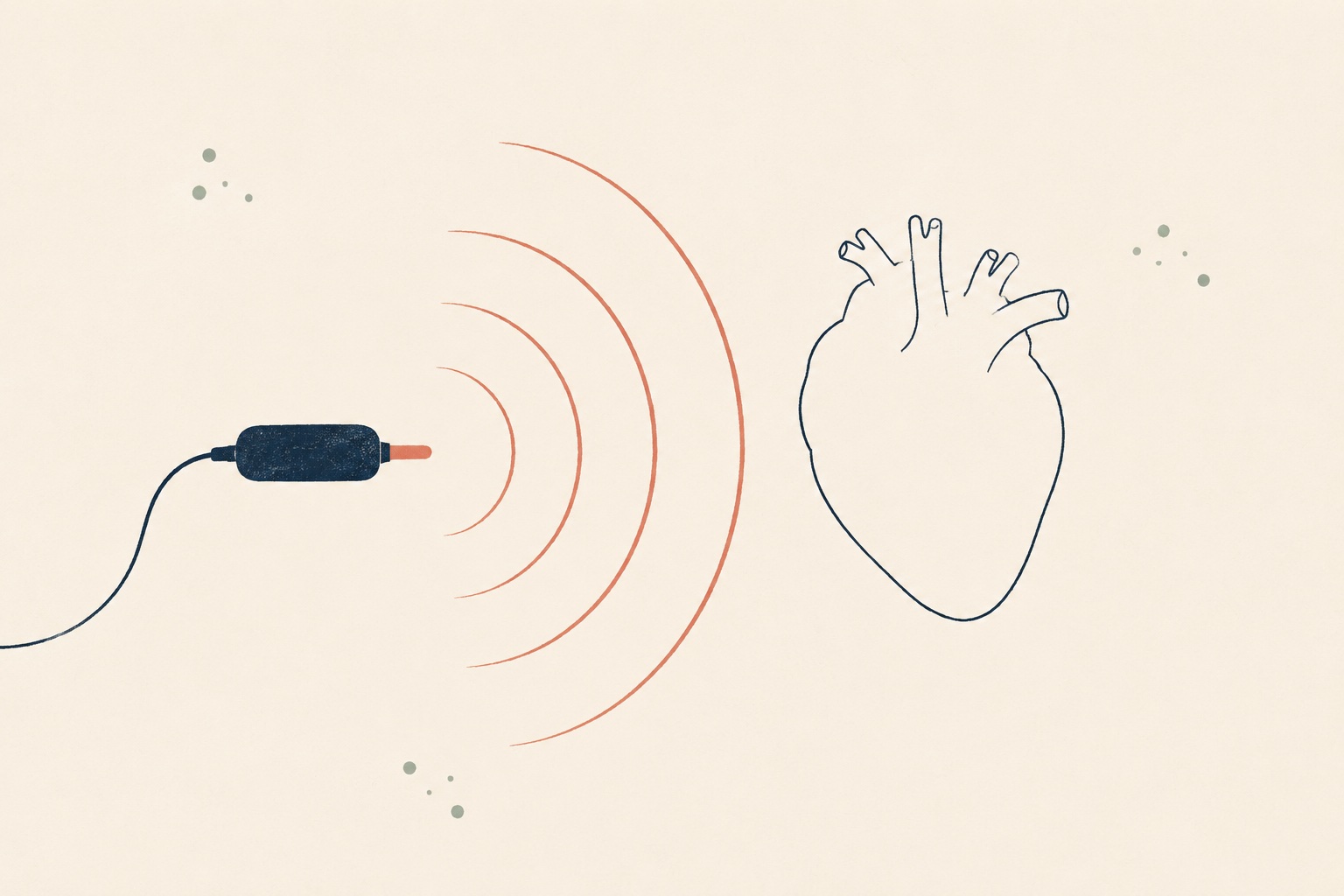
What a doppler hears, and what it cannot hear
A doppler bounces high-frequency sound off moving blood and turns the returning frequency shift into an audible sound. It answers exactly two questions: is there a heartbeat, and how fast.
Congenital heart disease is, overwhelmingly, a problem of structure - chambers that did not form completely, walls with holes, valves that are narrow, great arteries that are switched or narrowed. A screening ultrasound examines that structure across four standard views. A doppler, home or hospital, does not examine structure at all.
This is the sentence at the center of this page: a baby can have a serious heart defect and a heartbeat that sounds completely normal. Rate and rhythm stay ordinary across many major lesions. Hearing the heart tells you it is working; it tells you nothing about how it is built.
Evidence
The four-view structural screening standard - four-chamber plus outflow tracts - is defined in the ISUOG fetal cardiac screening guideline: UOG 2023. Structure is what screening scans assess; heart-rate listening assesses none of it.
What the FDA actually says
Not a rumor and not a ban - a position the agency has stated repeatedly since 2014. In its consumer update on fetal ultrasound, the FDA:
- Classifies Doppler heartbeat monitors as prescription devices, "designed to be used by trained health care professionals"
- States they are "not intended for over-the-counter sale or use" and strongly discourages keepsake imaging and unsupervised home monitoring
- Notes that while there is no evidence of harm from ordinary use, ultrasound can slightly heat tissue, long-term effects are unknown, and "ultrasound should be done only when there is a medical need" - because uncontrolled home sessions have neither a clinical purpose nor a trained operator
The agency's stated concern is not that one listen will hurt a fetus. It is that untrained use produces "information that is interpreted incorrectly" - in exactly the two directions described below.
Evidence
FDA Consumer Update, "Avoid Unnecessary Imaging During Pregnancy" (Dec 2014), issued through the FDA Office of Women's Health: prescription-device classification and discouragement of OTC doppler use. Text quoted above.
The two ways a home doppler fails you
Failure one: panic
You cannot find the heartbeat. Before 12-14 weeks the device may simply be too early to work. Later, the baby may have moved, you may be aiming at the placenta or your own vessels (a home doppler will dutifully amplify the mother's pulse, usually in the 60s-90s, as "the heartbeat"). Even experienced midwives sometimes hunt for minutes.
The typical result is a midnight emergency call or an emergency-room visit that ends with a nurse finding the heart in forty seconds. No harm done, except to you - the fear you bought the device to manage, doubled and happening at 2 a.m.
Failure two: false calm
This is the failure that matters more on a site about heart findings. You listen, the heartbeat is there, it sounds like a galloping horse, and the fear dissolves. But if that baby has a structural heart problem, the doppler just told you everything was fine. Reassurance that is not evidence is not reassurance - it is a delay. For the specific conditions this site covers, delay is the one thing that costs options.
What actually helps, by week
- Before ~26 weeks no reliable home signal exists
- There is no home monitoring method with clinical meaning at this stage. What helps is structural: your appointment schedule, and the waiting-days toolkit for living inside the gap without marinating in fear. Appointments and time
- From ~26-28 weeks movement becomes the signal
- Babies settle into individual movement patterns; learning yours and noticing a meaningful change is the evidence-based form of home monitoring. Your maternity team can show you what counts as "reduced" for your baby. Movement counting, taught by your team
- After a heart finding the doppler answers the wrong question
- Your follow-up plan is already the right instrument: fetal echocardiography looks at the actual structure, on a schedule set by people who can act on what they see. A heartbeat sound adds nothing to that plan. Stay on your scan schedule
If you already own one
Nobody needs to throw anything away. The workable arrangement some families land on, with their team's knowledge: treat the doppler as an emotional object, not a medical one - never as a reason to skip or delay anything; never use "I heard the heartbeat" to override "something feels different"; and always let movement, not sound, be the thing you report to your team.
And if a heartbeat could not be found and the worry will not release you: that is what your maternity line is for. Calling them is not overreacting. It is the system working as designed.
Bring these to your next appointment
- Given my heart finding, is there anything I should be monitoring at home?
- When does movement counting start mattering for my baby, and what pattern is normal?
- What changes would you want a call about, at my stage?
- Is my next scan still the right interval, given that I have been anxious?